
Cellular agriculture is a new field of science that uses techniques from stem cell research, tissue engineering, and animal science to grow agricultural products directly from cells in a lab setting. Cultivated meat, also known as clean meat, has become a hot topic in recent years, generating considerable interest as a potential game-changer in the food industry. Many experts consider it a revolutionary advancement that could redefine how we think about meat production and consumption. If cultivated meat successfully overcomes the technical and economic challenges it currently faces, it could become one of the most groundbreaking technological innovations of the 21st century. Unlike trends such as space tourism, which cater to a niche market, cultivated meat is a technology with the potential to transform daily life and significantly improve living standards for people worldwide. Its impact could be as profound as the invention of the vacuum cleaner or the automobile, innovations that society now considers indispensable. Just as we cannot imagine life without these breakthroughs, cultivated meat has the potential to become an integral part of our lives, reshaping the way we produce and consume food.
“Meatification” describes how meat has gone from being a side item to becoming a central part of people’s diets worldwide. The meat industry accounts for approximately 3% of global GDP (including the value of crops used as animal feed), a share comparable to that of the automotive industry, one of the world’s largest industrial sectors. This highlights the significant economic pressure to maintain high levels of meat production. Meat was once consumed rarely or predominantly by wealthier groups, now it becomes a global phenomenon of daily diets. According to the Food and Agriculture Organization (FAO), the global population will reach 9.5 billion by 2050. With the world’s population, demand for meat is also expected to grow by 60% and 70%, respectively, by 2050. More than 70% of alternative proteins will be essential to meet this growth and satisfy future food and nutritional requirements. These innovations are being developed in response to ongoing discussions about the efficiency and long-term sustainability of traditional livestock production. Cultivated meat is one of the emerging approaches aimed at complementing existing food systems by offering an additional method of producing animal-based products.
What exactly is cultivated meat? Cultivated meat offers a new approach to producing animal protein, based on growing cells directly rather than through conventional animal farming. Unlike plant-based meat alternatives, which rely on soy, peas, or other plant proteins to mimic the taste and texture of meat, cultivated meat is an authentic animal product. The process (see Figure 1.) starts with a few animal cells of different sources (e.g. beef, pork, chicken, fish, seafood), which are placed in a specially designed nutrient-rich medium that encourages them to divide. Cultivated meat is produced in a highly controlled environment, allowing for strict safety and quality standards. Each stage of production is monitored to ensure that the final product is safe to eat. Since cultivated meat is grown in a sterile environment, it is not exposed to viruses, bacteria, or parasites. This ensures that it is pure and free from contaminants. Moreover, it may reduce the need for certain inputs, such as antibiotics, which are otherwise used in some forms of livestock farming. This minimizes the risk of antibiotic-resistant bacteria.
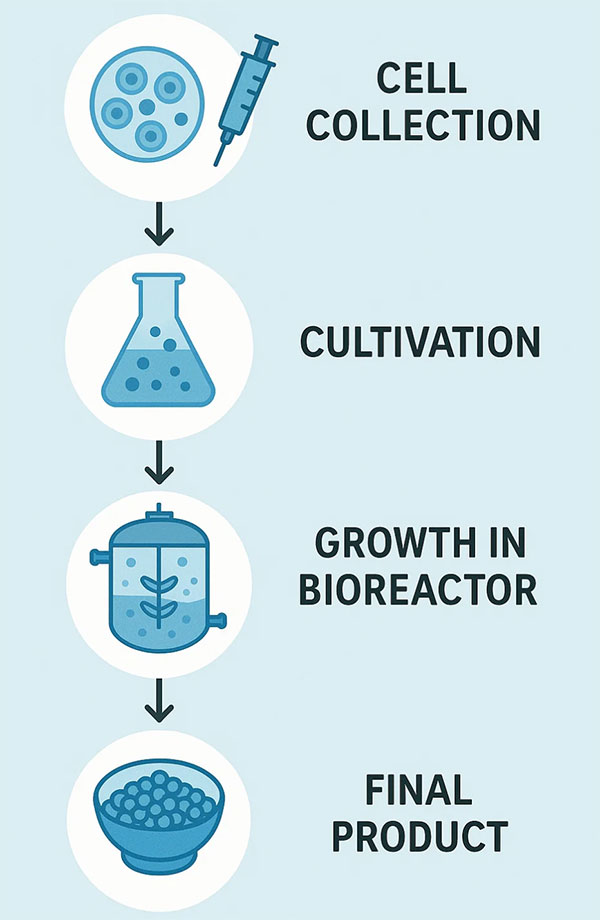
Figure 1. Process of cultivated meat.
While similar processes occur naturally within the organism’s body, the cultivation of meat is significantly more efficient. Nature is a master of optimization, designing plants and animals to survive with minimal resources. For example, cows are adapted to thrive on low-quality food sources like grass, thanks to their ability to digest cellulose. However, a significant portion of the nutrients they consume is converted into non-edible parts of their bodies, such as hooves or horns. These structures were once crucial for a cow´s survival in the wild, serving as the protection against predators or aiding in escape. Yet, they hold no value when it comes to human consumption. Cultivated meat revolutionizes food production. Instead of raising a cow for months or even years to obtain only select parts of its body, we can use bioreactors (a device that creates a controlled environment for expanding animal cells) to grow exactly what we need: muscle and fat. These bioreactors provide a carefully controlled environment that enables cell growth. While they might be considered complex systems, their purpose is to create an exceptionally efficient process. With minimal inputs, such as inorganic materials (non-living components) and small amounts (one-tenth) of organic nutrients (derived from plants), they produce precisely what is required. This approach saves resources, time, and energy. Cultivated meat is often described as an ethical and sustainable alternative. By reducing the need for land, water, and greenhouse gas emissions, cultivated meat offers a more environmentally friendly option.
While the potential is enormous, there are still some specific technical challenges that need to be resolved. Many of these challenges have to do with creating the right nutrient media, used to grow animal muscle cells. Another challenge is also creating the structure of real meat. It’s likely that the first products to reach the market will be unstructured like minced meat or nuggets, meaning they won’t have the familiar texture of whole cuts like steak or chicken breast. One approach might be to grow the cells on an edible scaffold, which would help shape the meat as it grows. However, making sure that oxygen and nutrients reach every part of this structure, as well as encouraging the cells to develop into different types of tissue, will be a complex challenge.
One of the key advantages of cultivated meat lies in its scalability and the significant qualitative shift it represents in the way food is produced and consumed. This product has the potential to succeed without relying on subsidies or artificial market interventions, as subsidies often distort natural market dynamics, much like inflation undermines financial stability. With its groundbreaking potential, cultivated meat should not require such support to thrive. In the current era of regulations and subsidies, the success of an innovation should not depend on external financial aid or imposed adoption. When a critical mass of individuals recognizes the value and inherent logic of a product, natural adoption tends to follow. Cultivated meat is a solution so transformative that it speaks for itself, creating a ripple effect capable of redefining the future of food production.
Cultivated meat is currently experiencing a surge in popularity and global attention. Although it has so far been approved for human consumption only in Singapore and the United States, the sector is expanding rapidly. A diverse range of stakeholders, including biotechnology firms, food tech startups, major food corporations, NGOs, and investors, are entering the field, drawn by its transformative potential. This includes both private investors and large agrifood companies such as Cargill, JBS, and Tyson Foods. In 2021 alone, global investments in the cultivated meat sector reached approximately 5.6 billion USD, underscoring strong momentum and growing confidence in the long-term viability of this technology. Most cultivated meat producers are small startups operating under a business-to-consumer model. These ventures, often backed by private funding, are developing a broad spectrum of products, from familiar favorites like burgers and meatballs to more niche offerings such as seafood and foie gras. This influx of activity reflects not only optimism about the scalability and market potential of cultivated meat, but also a shared ambition to reshape food systems in a more ethical, sustainable, and efficient direction. Meanwhile, the topic of cultivated meat innovation has attracted increasing attention in academic and industry literature, particularly in the areas of technology development, food safety, and consumer acceptance. Encouragingly, consumer interest appears to be growing as well: according to a recent Euroconsumers survey, 44–56 % of respondents expressed willingness to try cultivated meat. The ecosystem is evolving into a global innovation landscape, where coordinated efforts across science, industry, and regulatory policy are essential to overcoming remaining technical and legislative barriers.
Resources:
Benussi, C.; Samoggia, A. A Systematic Literature Review of Cultured Meat Through the Conceptual Frameworks of the Entrepreneurial Ecosystem and Global Value Chain. Foods, 2025, 14, 885. https://doi.org/10.3390/foods14050885
Biscarra-Bellio, J. C.; de Oliveira, G. B.; Marques, M. C. P.; Molento, C. F. M. Demand changes meat as changing meat reshapes demand: The great meat revolution. Meat Science 2023, 196, 109040. https://doi.org/10.1016/j.meatsci.2022.109040
Euroconsumers. Is there a place for cultivated meat on consumers’ plates? 2025. Available online: https://www.euroconsumers.org/wp-content/uploads/2025/05/Cultivated-meat-final_web.pdf
FAO. 2009. Available online: https://www.fao.org/fileadmin/templates/wsfs/docs/expert_paper/How_to_Feed_the_World_in_2050.pdf
Janoušek, J. Growth factors in cultivated meat production. Bachelor’s thesis, Charles University 2024.
O´Neill, E. N.; Cosenza, Z. A.; Baar, K.; Block, D. E. Considerations for the development of cost-effective cell culture media for cultivated meat production. Comprehensive Reviews of Food Science and Food Safety, 2020, 1–24. https://doi.org/10.1111/1541-4337.12678
Reiss, J.; Robertson, S.; Suzuki, M. Cell Sources for Cultivated Meat: Applications and Considerations throughout the Production Workflow. International Journal of Molecular Sciences, 2021, 22, 7513. https://doi.org/10.3390/ijms22147513
Song, H.; Chen, P.; Sun, Y.; Sheng, J.; Zhou, L. Knowledge Maps and Emerging Trends in Cell-Cultured Meat since the 21st Century Research: Based on Different National Perspectives of Spatial-Temporal Analysis. Foods 2024, 13, 2070. https://doi.org/10.3390/foods13132070
Statista. Worldwide meat market revenue 2024. Available online: https://www.statista.com/outlook/cmo/food/meat/worldwide (accessed on 11 November 2024)
Food and Agriculture Organization of the United Nations (2023) – with major processing by Our World in Data. “Share of cereals allocated to animal feed – FAO” [dataset]. Food and Agriculture Organization of the United Nations, “Food Balances: Food Balances (-2013, old methodology and population)”; Food and Agriculture Organization of the United Nations, “Food Balances: Food Balances (2010-)” [original data]. https://ourworldindata.org/grapher/share-cereals-animal-feed (accessed on 11 November 2024)